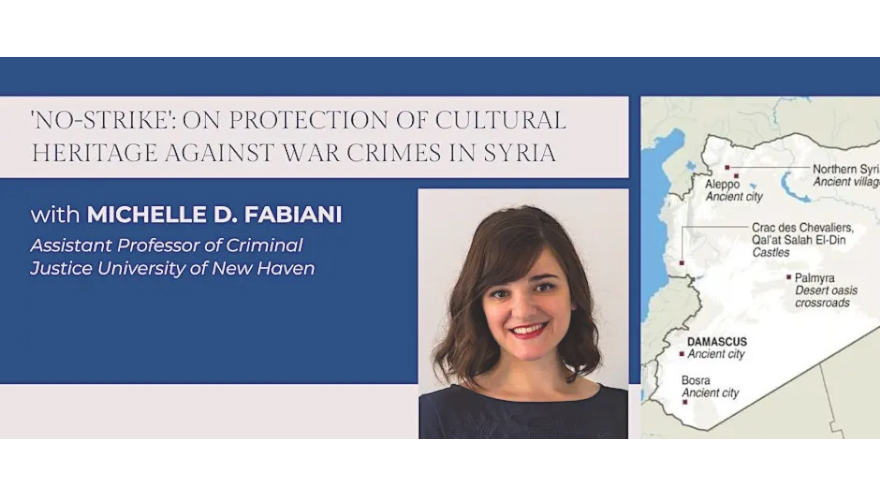
In collaboration with the University of Virginia and the Uppsala Conflict Data Program, researchers have conducted the first empirical evaluation of no-strike lists during the Syrian conflict.
During my postdoctoral training at the University of Virginia, prior to joining the University of New Haven as a tenure-track faculty member in the , I worked with colleagues in Sociology and the to understand the risks to cultural heritage and civilians during conflict.
Working with open-source reports of cultural heritage damage and destruction in Syria from 2014 to 2017, we systematically coded events and harmonized them with UCDP’s data on the Syrian conflict. My lab has continued to enhance these data since then, working with students both at the University of New Haven and the University of Virginia to incorporate new measures relevant to understanding the role of cultural heritage in contemporary conflicts.
I was honored to be invited to present the results of one of these lines of inquiry – surrounding the effectiveness of no-strike designations for cultural heritage sites during the Syrian conflict.
‘The first empirical attempt to evaluate effectiveness’
The 1954 Hague Convention mandates that all member states actively seek to protect and mitigate harm to key sites in a conflict. These collateral objects (defined by the Law of War) are civilian and noncombatant in nature. They can include hospitals, schools, cultural centers, and many types of cultural heritage sites (churches, mosques, archaeological sites, museums, ruins, shrines, etc.). Failure to protect these cites violates international law and may be considered a war crime.
Yet the designation of a cultural heritage site as part of a no-strike list is not straightforward. Not all countries maintain no-strike list inventories for a variety of reasons, including the risk of misuse and abuse. If multiple countries are involved in a conflict, they may share their lists, but they may also choose to create their own.
Thus, there may be different lists compiled by different governments in a conflict, and which sites are actively on the list may change over time depending on military necessity. The sites that are on the final list are, thus, the result of many military, political, ethical, legal, and social considerations.
Such lists have been in use since the Hague Convention was passed, but how do we know they are effective in their stated goal? Few have tried to evaluate them due to the difficulties of obtaining reliable information during conflict.
The analysis I presented is the first empirical attempt to evaluate effectiveness. The data we compiled represent as close to a complete set of attacks on cultural heritage sites as possible, combining verified and validated anonymized eyewitness reports, cell phone photos, satellite images, social media, and government reports. Similarly, the no-strike list we compiled is as complete a representation of the sites protected during the conflict as we can access.
‘Immense value of involving students’
Using a combination of spatiotemporal mixed-effects models and spatiotemporal discrete-hazard models, we were able to assess effectiveness across multiple dimensions. First, we looked at the baseline risk of attack on no-strike sites and then assessed given an attack how did the intensity of attack, type of attack, density of no-strike sites, and type of no-strike location affect the likelihood of no-strike sites being targeted.
Then, we explored whether state or nonstate actors were more likely to attack around no-strike locations. Third, we explicitly looked at whether civilian fatalities and attacks on cultural heritage sites collocate near no-strike locations. Finally, we considered whether no-strike sites provide a diffusion of benefit or harm, and if there is any evidence of displacement of attacks nearby.
An approach such as this has never been tried before, and it represents a new avenue for research into conflict dynamics and legal accountability. Through a systematic and methodologically rigorous approach to data preparation and analysis, it is possible to look at these phenomena in a new and useful way.
This approach also highlights the immense value of involving students in this work from the beginning. The students who worked on data preparation and analytical framing have all successfully found jobs that allow them to showcase their skills.
Contact
Get the highlights!
Stay up to date with our weekly e-newsletter, highlighting stories from around the University and media clips featuring our faculty experts.