The ºÚÁÏÍø³Ô¹Ï Blog
Understanding and Supporting Neurodivergent College Students
Dr. Ann Kline, OTD, OTR/L, the parent of a member of the Class of 2029, offers some tips to help support neurodivergent students throughout their time as ºÚÁÏÍø³Ô¹Ïs.
University News
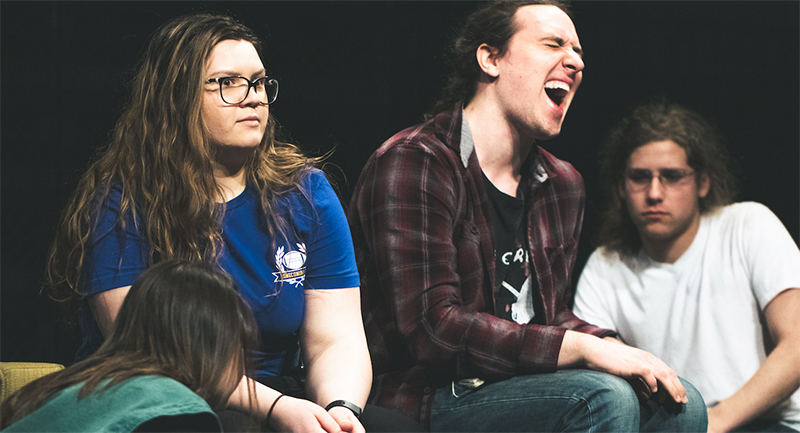
A comedic thriller, "Mr. Burns, a Post-Electric Play" explores the human response to catastrophe, as well as the role of storytelling and live performance in the forging of community, history, and survival. The curtain comes up April 24 to 27 at 7:30 p.m. in Bucknall Theater in Dodds Hall.
April 23, 2019

Bobby DellaCamera ’19 says preparing to play the roles of Gibson and Mr. Burns in the University’s production of "Mr. Burns, A Post-Electric Play" has been challenging and rewarding.
"The play is extremely complex," said DellaCamera. "It pulls at every human emotion and heartstring. Each moment must be thought out, understood, and talked about. I think the biggest thing I have learned from this play would be the ability to connect as human beings."
Anne Washburn’s "Mr. Burns, A Post-Electric Play" dares to ask what would happen if catastrophe struck and the electrical grid collapsed. It was named by New York Times theater critics as one of the 25 greatest plays of the past 25 years.
The curtain comes up in Bucknall Theater in Dodds Hall.
Ariana Lasher ’20, who plays two different characters, agrees that performing in these roles is demanding, since the show spans more than 80 years and each act is unique, requiring something different from her as an actor.
"This play points out that the amenities and luxuries we have today can disappear at any moment, and it explores how people may find themselves struggling to hold on," said Lasher, a theater arts major. "Mr. Burns will hopefully encourage the audience think about our current society and what it could become."
"What I love most about this production is how adventurous it is. It's such a unique show that explores one-of-a-kind topics. It draws you in."Rebecca Satzberg ’20
Meg Savilonis, associate professor and co-coordinator of the University’s theater program and the play’s director, says the show’s theme is relevant. In her theater history course, she has been exploring how theater practitioners in the 21st century must contend with a variety of digital forms of entertainment, and she says that live performance is a crucial component of Mr. Burns.

"Community is forged in the theater through the collaboration of artists, as well as the relationship between performers and spectators," she said. "That idea is especially important to me in a world that is increasingly dominated by interfacing with screens, avatars, and virtual realities."
In Mr. Burns, even the sound effects are live, performed by Rebecca Satzberg ’20. The show’s Foley artist, she recreates sound effects with everyday objects.
"What I love most about this production is how adventurous it is," said Satzberg, a music and sound recording major with minors in economics and theater arts. "It's such a unique show that explores one-of-a-kind topics. It draws you in."
Satzberg and Savilonis work closely with Matt Hodulik ’19, the play’s sound designer, to ensure that the sound in the script best suits the show, a challenge that encourages collaboration, innovation, and exploration.
"We use live Foley because the show is set after an apocalypse, which means the power grid has been shut down," said Hodulik, a music and sound recording major. "The challenge has been to figure out what sounds should be created by the Foley artist and what sounds I need to find or create myself."
The ºÚÁÏÍø³Ô¹Ï Blog
Dr. Ann Kline, OTD, OTR/L, the parent of a member of the Class of 2029, offers some tips to help support neurodivergent students throughout their time as ºÚÁÏÍø³Ô¹Ïs.
The ºÚÁÏÍø³Ô¹Ï Blog
University of New Haven students share how a hands-on pH experiment and community outreach program led to national recognition at the American Institute of Chemical Engineers’ K-12 STEM Outreach Competition.
The ºÚÁÏÍø³Ô¹Ï Blog
A screening of the film The Right Track and a thought-provoking panel of experts brought together advocates, law enforcement, and survivors to explore anti-trafficking solutions rooted in dignity and policy reform.